Business Buyer School Research · Article
Which Small Businesses Are Most Exposed to AI? It Depends Who Is Measuring
Legal services top one ranking of 81 industries and sit 39th on another. The groups at each end are steadier than any single number.
Published October 5, 2026 · Free to read · Based on the in-depth report The Small-Business Industries Most Exposed to AI, edition 3.0
Rankings of the jobs and industries "most exposed to AI" have become a genre. They are usually reported as a single list with a single winner. Business Buyer School built one for 81 industries where buying a small business is realistic, and then did something most lists skip: we ran it again with different yardsticks.
The top of the list barely moved as a group. The order inside it moved a lot.
What exposure means
Exposure is a measure of overlap. Researchers rate each occupation on how much of its work resembles things AI can assist with or perform. We combine those ratings with the federal count of which occupations each industry employs. An industry full of highly rated occupations gets a high score.
That is all the score says. It is not a forecast of layoffs, lost revenue or closures. A highly exposed business may use AI to do more with the same staff, may see customers do the work themselves, or may see no change.
The most exposed industries
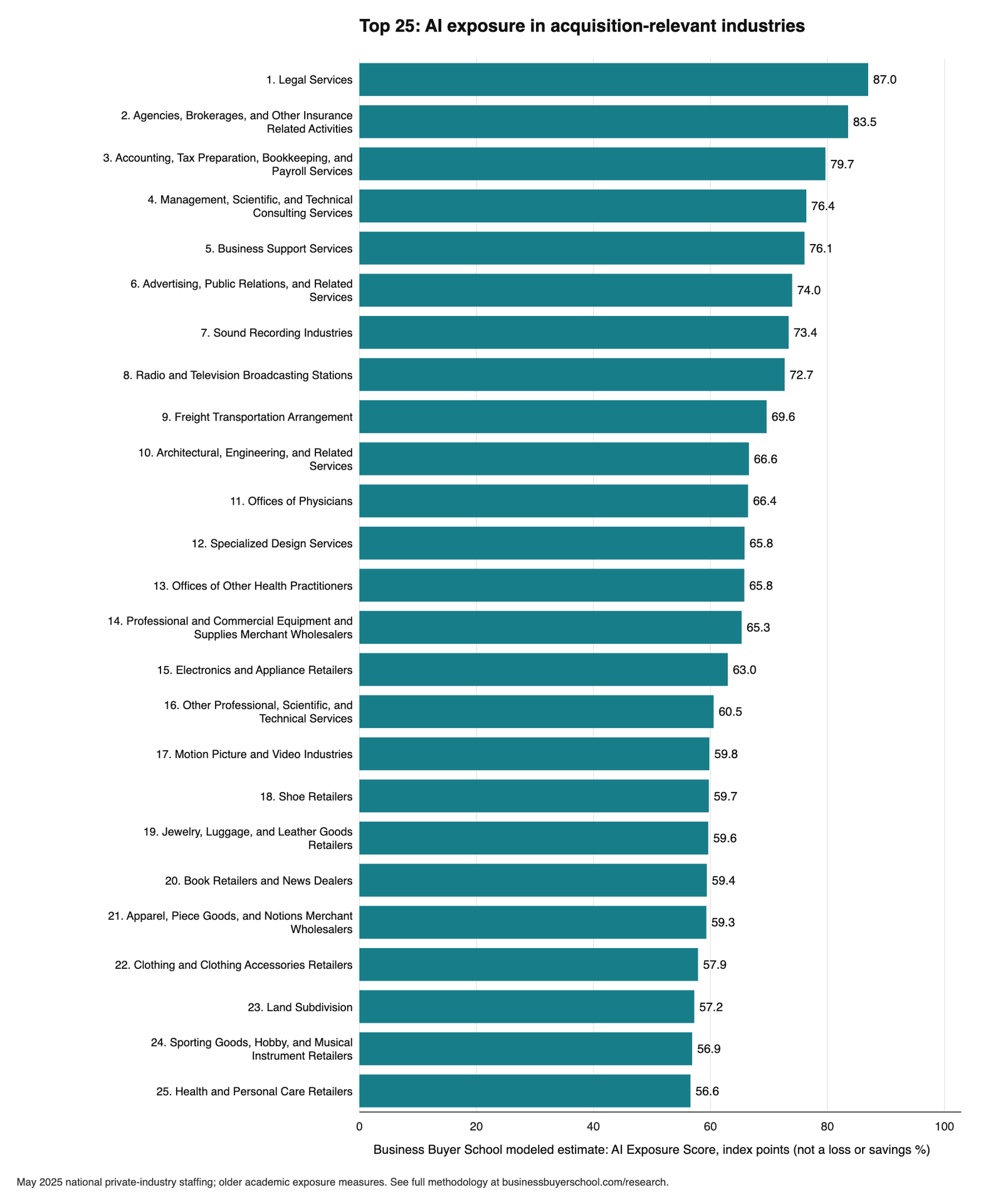
| Rank | Industry | Exposure score (0 to 100) | Rank on a second research measure | Rank on a measure built from real AI use |
|---|---|---|---|---|
| 1 | Legal services | 87.0 | 3 | 39 |
| 2 | Insurance agencies and brokerages | 83.5 | 1 | 6 |
| 3 | Accounting, tax preparation, bookkeeping and payroll | 79.7 | 4 | 13 |
| 4 | Management and technical consulting | 76.4 | 7 | 12 |
| 5 | Business support services | 76.1 | 2 | 1 |
| 6 | Advertising and public relations | 74.0 | 6 | 5 |
| 7 | Sound recording | 73.4 | 9 | 29 |
| 8 | Radio and television broadcasting | 72.7 | 5 | 4 |
| 9 | Freight transportation arrangement | 69.6 | 12 | 18 |
| 10 | Architectural and engineering services | 66.6 | 10 | 21 |
These are office-based services whose product is information: documents, analysis, advice, coordination. 15 industries stay in the top 25 whichever of four measures is used.
The least exposed
| Rank of 81 | Industry | Exposure score |
|---|---|---|
| 81 | Sawmills and wood preservation | 21.7 |
| 80 | Services to buildings and dwellings (cleaning, landscaping, pest control) | 22.6 |
| 79 | Foundation, structure and exterior contractors | 23.6 |
| 78 | Waste collection | 24.0 |
| 77 | Highway, street and bridge construction | 24.6 |
| 76 | Other specialty trade contractors | 25.5 |
| 75 | Building finishing contractors | 25.7 |
| 74 | Support activities for road transportation (towing and similar) | 27.9 |
The bottom of the list is hands-on work: construction, waste, wood products, cleaning and grounds services. Building equipment contractors, the federal category covering plumbing, HVAC and electrical firms, rank 64th of 81. Auto repair ranks 70th.
Where the yardsticks disagree
Our main measure, from 2023, rates occupations by the abilities they require. A newer one, published in 2025, looks at what people actually ask an AI assistant to do. For most industries the two agree. For some they do not.
| Industry | Rank on the main measure | Rank on the real-use measure |
|---|---|---|
| Legal services | 1 | 39 |
| Offices of physicians | 11 | 51 |
| Offices of dentists | 27 | 76 |
| Personal care services | 38 | 80 |
| Gasoline stations | 35 | 10 |
| Beer, wine and liquor stores | 29 | 9 |
| Shoe stores | 18 | 2 |
Lawyers, physicians and dentists do work that looks, on paper, like what language models are good at. The real-use measure, drawn from conversations with one AI assistant, shows much less of that work so far. Retail runs the other way: store and sales work shows up heavily in real use. 7 of the top 25 industries on the main measure are retail categories.
17 of the 81 industries move more than a quarter of the list between measures. For those, a single rank is not worth quoting without its range.
What is not on the list
Only industries with enough matched data are ranked. Restaurants, home health care, child care and computer systems design are left out for that reason, not because their exposure is low. Categories that rarely change hands as small businesses, such as insurers, lenders, nonprofits and holding companies, are also excluded.
Federal industry categories are broad. There is no separate score for an HVAC company or a landscaper, only for the larger group each belongs to.
Adoption so far
The Census Bureau reports that 23.8% of U.S. businesses used AI in the two weeks ending September 6, 2026. Use is highest in information (49.0%), professional services (43.9%) and finance (41.0%), the same sectors that score highest on exposure, and lowest in construction (15.4%) and accommodation and food services (10.1%).
What a buyer can do with this
- Use the list to ask better questions, not to pick an industry. High exposure means the work is changing, in either direction.
- Find out what the customer pays for. Routine document production and accountable advice can sit in the same firm and face very different pressure.
- Check more than one measure. If an industry's rank swings by thirty places depending on the yardstick, treat it as an open question.
- Look at the specific business. The scores describe a national mix of employers of every size, not the company for sale.
How the numbers were built
Scores and ranks in this article are Business Buyer School modeled estimates. They combine the Bureau of Labor Statistics' May 2025 count of occupations in each industry with published research ratings of each occupation's exposure to AI. Adoption figures are official Census Bureau statistics. The exposure ratings are older than today's AI systems. Exposure is not a prediction of job loss, lost revenue or business failure.
Cite as: Business Buyer School (2026). The Small-Business Industries Most Exposed to AI: 2026 Industry AI Exposure Study, edition 3.0. https://businessbuyerschool.com/research/ai-exposure-by-industry/. Full tables, methods and sensitivity tests are in the in-depth report at the same address.
Go deeper
Read the in-depth report with every table, the method and the sensitivity tests, or download the data. Companion article: Where AI Could Take Work Off a Small Business's Desk.
Writers and editors may quote this article and reproduce its tables with the credit "Business Buyer School Research, businessbuyerschool.com" and a link to this page. See the media sheet.
Take this into your own search
Industry research is context, not a verdict on any one business. These free parts of the school show how to use it.
- Write your Buy Box: set the type of business, size and hard exclusions before you search.
- Cleaning, landscaping and HVAC compared: how the same principles show up in three trades.
- See the curriculum or start free with Business Buyer School.