Business Buyer School Research · Article
Where AI Could Take Work Off a Small Business's Desk
An analysis of 81 industries finds the popular picks are not the clearest cases
Published October 5, 2026 · Free to read · Based on the in-depth report Where AI Could Create the Most Operating Leverage for Small-Business Buyers, edition 3.0
Ask which small businesses stand to gain most from AI and you tend to hear the same list: plumbers, HVAC contractors, auto shops. The reasoning is easy to follow. Software cannot fix a furnace, but it can book the appointment, draft the quote and send the invoice. So the work stays and the overhead shrinks.
Business Buyer School tested that idea against federal staffing data for 81 industries where buying a small business is realistic. The reasoning holds up. The list is shakier.
Two questions, not one
Most AI rankings ask a single question: how much of an industry's work looks like work AI can help with? That lumps together two very different situations. In an accounting firm, the exposed work is the product. In a machinery repair shop, the exposed work is the office around the product.
So we asked two questions of every industry. First, how exposed is the work the business actually sells? Second, how much exposed office work sits around it: scheduling, billing, bookkeeping, purchasing, customer service, management?
That gives four kinds of industry.
| What it looks like | Examples from the data | |
|---|---|---|
| Office leverage | The service is hard for AI; a large share of staff does exposed office work | Residential builders, machinery repair, parts wholesalers, printers |
| Both exposed | AI reaches the product and the office | Accounting, insurance agencies, consulting, advertising |
| Product exposed, little office | The front-line work rates as exposed and there are few office staff | Most retail stores and personal care; medical and dental offices on one of the measures |
| Neither | Hands-on work and a thin office | Building trades, waste collection, food manufacturing, cleaning services |
Where firms say they use AI today
The office is where AI is already showing up. The Census Bureau reports that 23.8% of U.S. businesses used AI in the two weeks ending September 6, 2026. In its 2026 supplement, the most common uses were sales and marketing (14.3% of all firms), strategy (12.4%) and information technology (11.4%). Producing goods came in at 1.7%.
Firms that use AI mostly describe it as help, not replacement. 43.7% said they used it to supplement a task an employee performs; 10.1% said it performed a task an employee used to do. Asked about headcount, 95.7% reported no change.
The clearest cases are not the famous ones
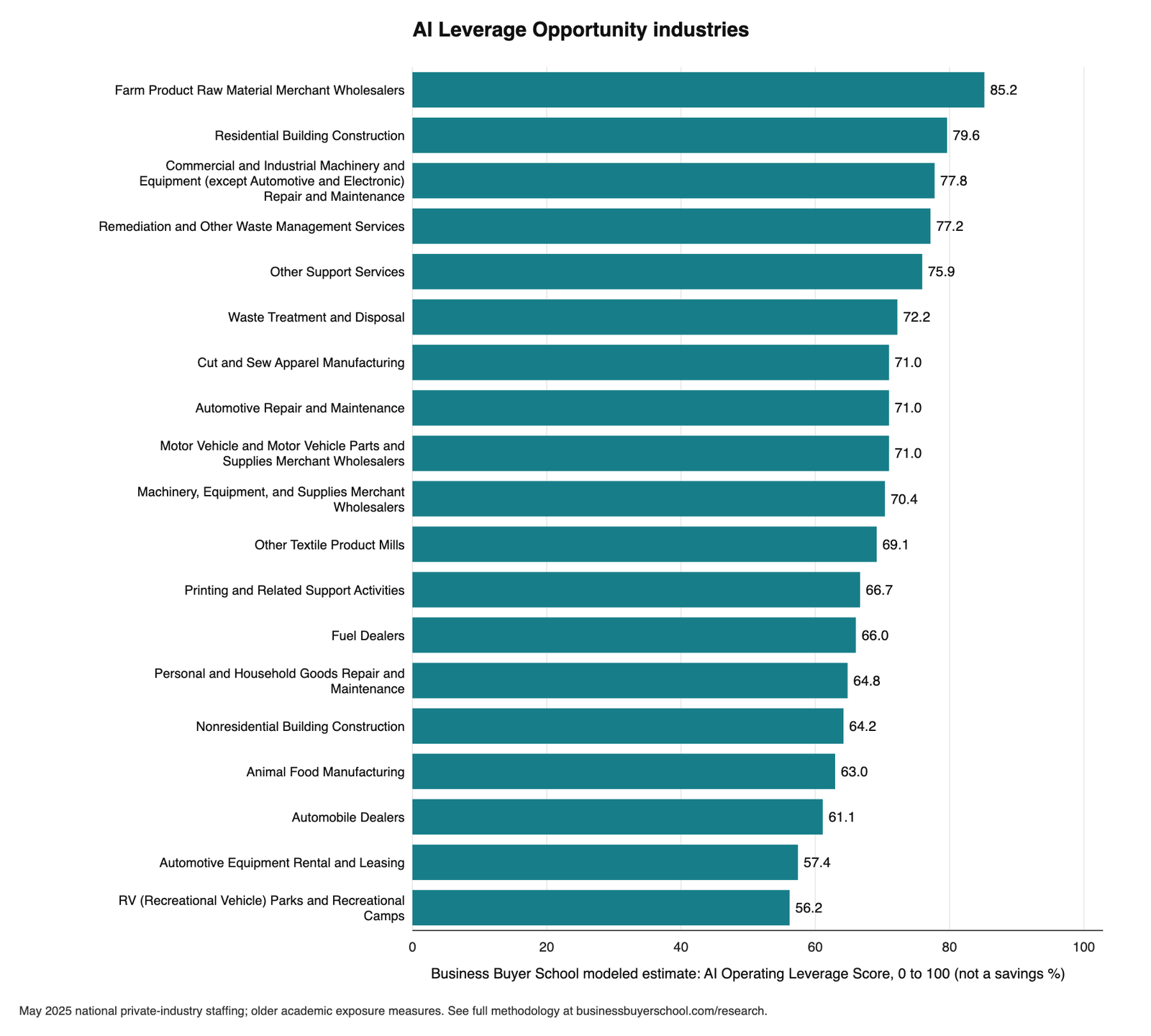
19 of the 81 industries fall in the office-leverage group. The ones that stay there however the lines are drawn are a less glamorous set.
| Industry | Share of jobs in office and management roles | Exposure of the core work (0 to 100) | Holds under alternative definitions |
|---|---|---|---|
| Farm product wholesalers | 24% | 24.0 | 7 of 8 |
| Residential building construction | 22% | 26.5 | 8 of 8 |
| Commercial and industrial machinery repair | 22% | 24.0 | 7 of 8 |
| Remediation and other waste management | 21% | 24.5 | 8 of 8 |
| Other support services (packaging, trade shows, auctions and similar) | 24% | 34.2 | 8 of 8 |
| Waste treatment and disposal | 18% | 23.7 | 6 of 8 |
| Cut and sew apparel manufacturing | 18% | 27.0 | 8 of 8 |
| Motor vehicle parts wholesalers | 23% | 35.2 | 8 of 8 |
| Other textile product mills | 17% | 24.2 | 7 of 8 |
| Printing | 21% | 35.0 | 8 of 8 |
For comparison, the typical industry in the study has 16% of its jobs in office and management roles. Residential builders have 22%. Machinery repair shops have 22%.
What about the trades?
Building equipment contractors, the federal category that combines plumbing, HVAC and electrical firms, have some of the least exposed core work in the study: 27.2 on a 100-point scale. That half of the popular story is right.
The other half is closer to average. About 18% of jobs in those firms are office and management roles, close to the middle of the pack. On our main definition the category lands just outside the office-leverage group. Auto repair lands just inside it. Change the definition slightly and each one switches sides. Both hold their place in only 4 of 8 versions we ran.
That is not a verdict against the trades. It means the national numbers neither confirm nor rule out the thesis, and there is a reason they may understate it. The staffing data count employees. In a five-person shop, the person doing the estimates, the schedule and the books is often the owner, and owners are not in the data.
Where AI reaches the product itself
At the other end are industries where the exposed work is what the customer pays for: legal services, insurance agencies, accounting and bookkeeping, management consulting, business support services. They rank highest on overall exposure, and their office work is exposed too.
High exposure is not a forecast of decline. It says a large share of the work resembles work that researchers rate as something AI can assist with or perform. Whether that turns into lower costs for the firm, lower prices for its customers, or nothing at all is a separate question the data cannot answer. The ranking also depends on the yardstick. Legal services rank first on the measure we use as our main one and 39th on a newer measure built from how people actually use an AI assistant.
Small firms are not far behind
One assumption the Census figures challenge is that the smallest businesses are sitting AI out.
| Employees | Share using AI |
|---|---|
| 1 to 4 | 23.8% |
| 5 to 9 | 21.1% |
| 10 to 19 | 23.0% |
| 20 to 49 | 24.5% |
| 50 to 99 | 29.4% |
| 100 to 249 | 34.1% |
| 250 or more | 44.0% |
The largest firms lead by a wide margin. But firms with one to four employees report slightly more use than firms with five to nineteen. By sector, use runs from 49.0% in information and 43.9% in professional services down to 15.4% in construction and 10.1% in accommodation and food services.
What a buyer can do with this
- Look at the office, not the label. The question is not whether a business is a trade. It is how many paid hours go to scheduling, quoting, billing and follow-up, and who does them.
- Count the owner's hours. If the seller does the paperwork at night, that work is real even though no payroll record shows it.
- Treat savings as a plan, not a price. Buy the business on its verified cash flow. List any AI improvement separately, with its cost and a way to measure it.
- Ask who keeps the gain. Faster quoting can raise margins, or it can simply become what customers expect.
How the numbers were built
Scores, ranks and groupings in this article are Business Buyer School modeled estimates. They combine the Bureau of Labor Statistics' May 2025 count of occupations in each industry with published research ratings of how exposed each occupation is to AI. Office and management roles are treated as overhead unless an industry employs them at three or more times the national rate, in which case they are counted as the product. Adoption figures are official Census Bureau statistics.
The study ranks 81 industries. Others, including restaurants, home health care and child care, could not be scored reliably and are left out; that does not mean their exposure is low. Federal industry categories are broad: there is no separate figure for HVAC, plumbing or landscaping. The data cover employers of every size, not only small ones. Exposure is not a prediction of job loss, lost revenue or savings.
Cite as: Business Buyer School (2026). Where AI Could Create the Most Operating Leverage for Small-Business Buyers: 2026 AI Opportunity Study, edition 3.0. https://businessbuyerschool.com/research/ai-office-opportunity/. Full tables, methods and sensitivity tests are in the in-depth report at the same address.
Go deeper
Read the in-depth report with every table, the method and the sensitivity tests, or download the data. Companion article: Which Small Businesses Are Most Exposed to AI? It Depends Who Is Measuring.
Writers and editors may quote this article and reproduce its tables with the credit "Business Buyer School Research, businessbuyerschool.com" and a link to this page. See the media sheet.
Take this into your own search
Industry research is context, not a verdict on any one business. These free parts of the school show how to use it.
- Write your Buy Box: set the type of business, size and hard exclusions before you search.
- Cleaning, landscaping and HVAC compared: how the same principles show up in three trades.
- See the curriculum or start free with Business Buyer School.